Commercial air transport operations — stricter rules
Part 170
Air Traffic Rules
Part 175
Aeronautical Information Services
A · Regulations — 3
AIP
The State's official publication of permanent aeronautical information. The AIP does not create new law, but its content is binding because it is issued under CASR.
GEN
National regulations, differences from ICAO, units, and charges
ENR
Airspace, ATS routes, IFR rules, flight plan procedures, restricted / danger areas
AD
Aerodrome data, SID / STAR / approach charts, and minima
Permanent changes, following the AIRAC cycle (Aeronautical Information Regulation And Control) every 28 days.
Temporary
AIP Supplement
Temporary changes that are lengthy or contain many graphics.
Informational
AIC
Circulars that are informational or explanatory.
A · Regulations — 4
NOTAM overrides the AIP
Notice of temporary or urgent changes not yet, or not needed to be, in the AIP — for example a runway closure, ILS out of service, or a temporary restricted area.
AIP · ADILS RWY 25AVAILABLE
NOTAMILS RWY 25U/SIN EFFECT
Minima increase
Approach changes to RNP / VOR
For its period of validity, a NOTAM overrides the AIP. Checking NOTAMs is a required part of preflight action — CASR 91.103.
A · Regulations — 4
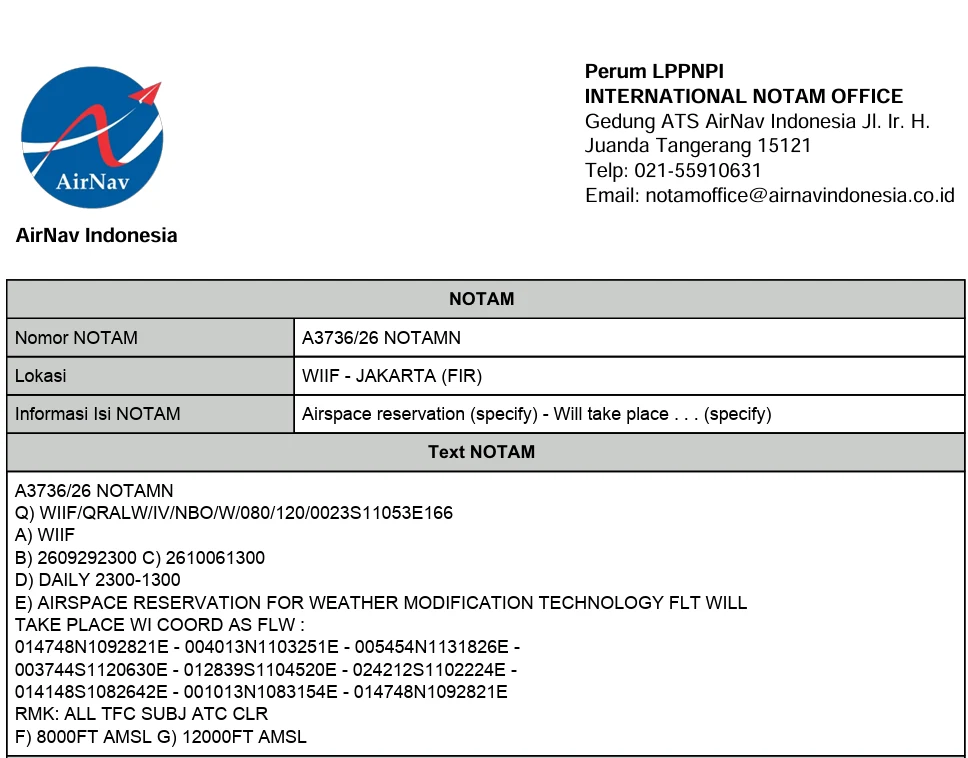
Reading a NOTAM
A)
WIIF — Jakarta FIR
B) C)
Valid 2609292300 to 2610061300 (YYMMDDhhmm, UTC)
D)
Schedule: DAILY 2300–1300
E)
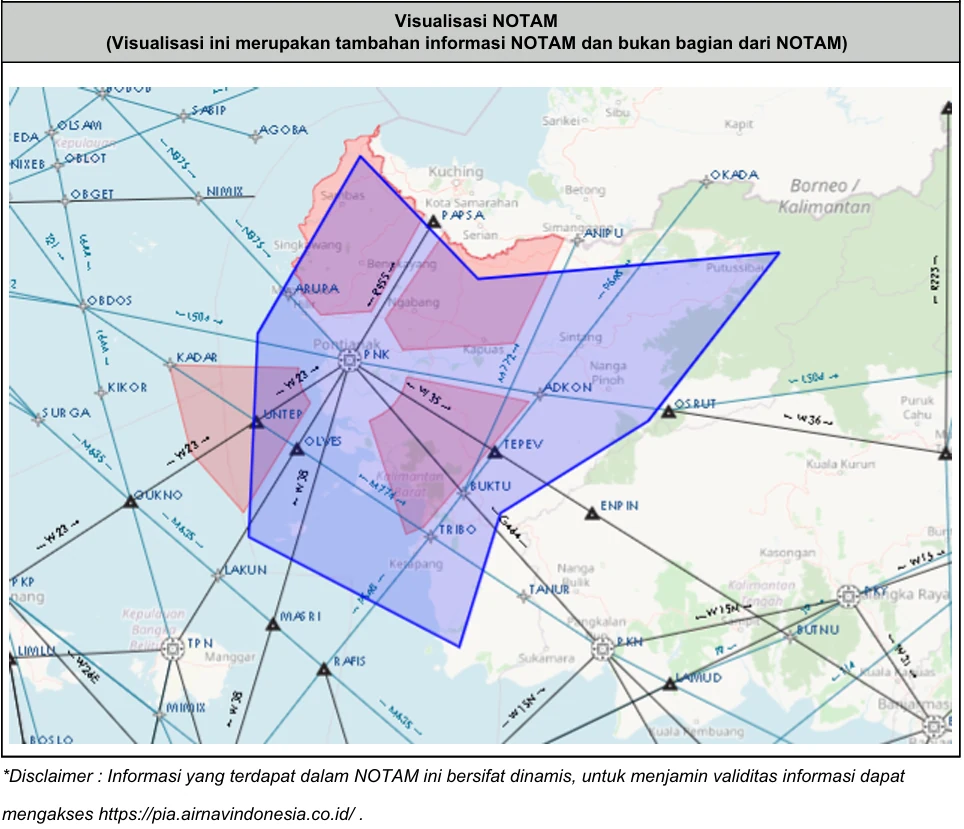
Airspace reservation for weather modification technology flights within the stated coordinates; RMK: ALL TFC SUBJ ATC CLR
F) G)
Vertical limits 8000 FT – 12000 FT AMSL
NOTAM information is dynamic — validate at pia.airnavindonesia.co.id.
A · Regulations — 5
ATC clearance
Real-time authorization from ATC to operate under specified conditions in controlled airspace.
For IFR, a clearance must be obtained before entering controlled airspace.
CodeComponentMeaning
CClearance limitDestination or waypoint
RRoutePath via SID, waypoints, or airways
AAltitudeInitial altitude and step climbs
FFrequencyATC communications
TTransponderSquawk code for radar identification
A · Regulations — 5
Dissecting a clearance
HALIM TOWER
C
Clearance limitJuanda Airport
R
RouteCA1Y departure RWY 06 → G461
A
AltitudeFL330
F
Frequency— Jakarta Director 119.75
T
TransponderSquawk 7201
CA ONE YANKEE DEPARTURE
Climb on heading 065°, at or above 1000 ft turn RIGHT, direct to
NIROGUGPOXPWASIPACA
A · Regulations — 5
Key clearance principles
Must be complied with
Once accepted, the pilot must comply with the clearance — except in an emergency or when an amended clearance is issued.
UNABLE
Not a blank check
A clearance does not relieve the pilot of other regulations or aircraft limitations. If it can't be followed due to performance, weather, or AFM limits — reply “UNABLE”.
7600
Lost comm
The procedures in CASR / AIP apply: route in the order AVEF, altitude the highest of MEA, expected, or assigned.
A · Regulations — 6 · Aircraft & operator track
AFM · MEL · SOP
Aircraft / Airplane Flight Manual
AFM
From the manufacturer, approved by the authority as part of type certification
The Limitations section is legally binding (CASR 91.9): speed limits, maximum weights, demonstrated crosswind, IFR / icing certification
No SOP, clearance, or company instruction may violate it
Minimum Equipment List
MEL
Derived from the manufacturer's MMEL, approved by DGCA for a specific operator
Equipment that may be inoperative at dispatch, (O) and (M) procedures, repair limits for categories A–D
One autopilot / FMS INOP can remove RVSM, CAT II/III, RNP AR
Operations Manual / SOP
OM / SOP
Written by the operator, approved / accepted by DGCA
Turns regulations and the AFM into daily procedures: callouts, stabilized approach criteria, company minima
Less strict
Baseline limit (regulation / MMEL)
Stricter
MEL relative to MMEL, and SOP relative to regulations: may be stricter, never less strict — for example company minima higher than chart minima.
Quiz · section A
Section A quiz
Loading questions…
Select one answer — it locks once submitted.
B
PK-ARO · PIPER ARCHER
B · CASR Part 91
IFR flight rules
General Operating and Flight Rules — basic operating rules for all civil aircraft, including non-commercial operations. IFR rules are in Subpart B (91.167 onward) and govern operations in Indonesian territory and FIRs.
The PIC must become familiar with all available information before flight. For IFR this includes:
Weather reports & forecasts
Fuel requirements
Alternatives if the flight cannot be completed
Traffic delays from ATC / ACO
CASR also adds critical fuel provisions aligned with ICAO:
final reserve
Stage 1MINIMUM FUEL
Committed to land at a specific airport; any clearance change or delay could result in landing below final reserve.
Stage 2MAYDAY MAYDAY MAYDAY FUEL
Estimated fuel on landing at the nearest suitable airport is already less than final reserve.
B · 1 Before flight
91.167 IFR fuel
1
Fly to the first airport of intended landing
2
Then fly from there to the alternate
3
+45 minutes at normal cruising speed (30 minutes for helicopters)
Example assumptionsBoeing 737-800WIHH → WARRAlternate WADDCruise FL350, TAS ±450 kt, no windFuel flow ±2,400 kg/hrJet A-1 ±0.8 kg/L
B · 1 Before flight
Calculating minimum fuel
1 · Trip fuel WIHH → WARR
Climb to FL350
130 NM
22 min
1,450
Cruise FL350
170 NM
23 min
920
Descent
110 NM
18 min
300
Approach & landing
—
10 min
400
Trip total
410 NM
73 min
3,070 kg
2 · Alternate WARR → WADD
Scenario: arrive at Juanda, missed approach, then proceed to Denpasar ±210 NM — typically at a lower level, e.g., FL250.
Missed approach
5 min
250
Climb to FL250
12 min
700
Short cruise
10 min
450
Descent, approach & landing
23 min
600
Alternate total
±50 min
±2,000 kg
3 · Final reserve 45 minutes
CASR 91.167: 45 minutes at normal cruising speed.
2,400 kg/hr×0.75 hr=1,800 kg
3,070 trip2,000 alternate1,800 reserve
CASR 91.167 minimum6,870 kg±8,590 liters
The logic: if all goes normally, the aircraft lands at Juanda with ±3,800 kg remaining (alternate + reserve) — that is the “insurance” if Juanda cannot be used.
B · 1 Before flight
91.169 Alternate required?
An IFR flight plan must list an alternate airport unless destination weather is good enough. In the FAR this is known as the 1-2-3 rule:
ETA − 1 hrETAETA + 1 hr
Destination forecast within this window shows…
1hour before & after ETA
2ceiling below 2,000 ft
or
3visibility less than 3 NM
→ alternate required
Standard alternate minima · precision
600ft ceiling1.7NM vis
Standard alternate minima · non-precision (FAR)
800ft ceiling1.7NM vis
91.173 · Clearance & flight plan
IFR in controlled airspace is permitted only after filing an IFR flight plan and receiving an ATC clearance.
Standard alternate minima apply when the approach procedure does not list alternate minima.
B · 2 Takeoff & landing
91.175 Below DA / MDA?
Permitted only if all three conditions are met:
The aircraft is continuously in a position from which a normal descent at a normal rate to the runway can be made
Flight visibility is not less than that prescribed in the procedure
At least one visual reference is distinctly visible — approach lights, threshold, runway markings, or runway lights
Any condition missing → missed approach required.
Takeoff minima: IFR takeoffs must meet the weather minima prescribed by the Director for that airport — fully binding for commercial operations (Part 121 / 135).
B · 3 En route
En route rules
91.177Minimum altitude
No lower than the MEA or the altitude charted. If none, the FAR requires 2,000 ft above the highest obstacle within 4 NM in mountainous terrain, and 1,000 ft elsewhere.
91.179Cruising level
Based on track (semicircular rule). Indonesia-specific details, including RVSM, are in AIP ENR 1.7.
91.181Course
Fly along the centerline of the airway or direct between the fixes that define the route.
91.183Communications
Report position at compulsory reporting points, unforecast weather, and other safety-of-flight hazards.
91.187Malfunction report
Report to ATC if navigation, approach, or communication equipment fails.
B · 3 En route
91.185 Lost communication
VFR conditions
Continue VFR
If radio failure occurs in VFR, or VFR conditions are later encountered: continue VFR and land as soon as practicable.
IMC conditions
Route · AVEF
A
Assigned — the last route assigned
V
Vectored — direct to the fix the vector was leading to
E
Expected — the route ATC advised to expect
F
Filed — the flight plan route
Altitude · highest of
MEAMinimum
Expectedhighest → use
Assigned
Illustration: use the highest value for the segment being flown.
Transponder
7600
Indonesia-specific lost comm procedures are also published in the AIP
B · 3 En route · 91.185
AVEF — route during lost comm
AVEF is a mnemonic for the route selection rule — click a letter to see its scenario.
Scenario
This is a selection order based on circumstances, not four routes flown in turn. Expected also means information from ATC, not the pilot's own assumption.
B · 4 Aircraft equipment
91.205(d) GRABCARD
In addition to day and night VFR equipment, an IFR aircraft requires:
GGenerator / alternatoradequate capacity
RRadiotwo-way communication & navigation appropriate to the route
ASensitive altimeteradjustable for barometric pressure
BBallslip-skid indicator
CClocksweep-second pointer / digital display
AArtificial Horizon (A/H)attitude: pitch & bank
RRate-of-turn indicator
DDirectional gyroheading indicator
B · 5 Qualifications & regulation hierarchy
Pilot & regulation layers
CASR Part 61 — not Part 91
Instrument rating
For the category of aircraft flown.
Recency · preceding 6 months
6instrument approach
+holding
+intercepting & tracking course
Not met → instrument proficiency check required.
Company OM / SOPadds further detail
Part 121 / 135 · commercialstricter: detailed fuel policy, takeoff alternate, higher alternate minima
Part 91minimum limits
AIP supplements
Indonesia-specific details: cruising level table, lost comm procedures, airspace classification
Quiz · section B
Section B quiz
Loading questions…
Select one answer — it locks once submitted.
C · Instruments & scanning
Control & monitoring
Attitude and power set the response; the other instruments verify the result.
ControlWhat are we setting?
Attitude: pitch & bank. Power: RPM / manifold pressure or the aircraft's power indicator.
PerformanceWhat is the result?
Airspeed, altitude, vertical speed, and heading.
NavigationWhere are we relative to the track?
Course, CDI / HSI, glideslope, distance, and position.
SystemsAre the systems normal?
Engine, fuel, electrical, vacuum (if installed), and warnings.
1Setattitude + power
2Trimrelieve control pressures
3Cross-checkevaluate trend & result
4Adjustsmall correction, then reassess
There is no universal pitch / power setting — adjust for aircraft characteristics, weight, configuration, and atmosphere, referencing the AFM / POH and SOPs.
C · Instruments & scanning
Instrument scanning techniques
On a glass cockpit (PFD)
T-Scan
Starting point
Eye movement
Best for
80–90%of eye time on the A/H
A/H = home base. Reference: Instrument Scanning Techniques · FAA-H-8083-15B
C · Instruments & scanning
Six-pack by phase
Phase 1 / 4
Straight-and-level
+ CDI / glideslope on navigation instruments
Primary focus
Supporting
Instructional illustration — dimmed instruments are still monitored, just not the primary focus; primary / supporting depends on the maneuver & SOP. · FAA-H-8083-15B
Quiz · section C
Section C quiz
Loading questions…
Choose one answer — it locks once submitted.
D · Glass cockpit & automation
Garmin G1000 — PFD & MFD
NAVHDG
APFDHDGALTNAVVNVAPRBCVSUPFLCDN
ALT
COMCRS BARORANGEFMS
PFD — Primary Flight Display
NAVHDGALT
COMCRS BARORANGEFMS
MFD — Multi-Function Display
1
Illustrative replica for training — layout & logic follow the Garmin G1000 / GFC 700 Pilot's Guide and your aircraft's AFMS.
D · Glass cockpit & automation
Autopilot key functions
APFD
AP / FD
AP engages the autopilot servos. FD only displays the magenta command bars — the pilot flies. AP with no other mode → ROL + PIT.
HDG
HDG + heading bug
The aircraft turns to the heading bug (cyan) and holds it. Set the bug with the HDG knob; pushing the knob = sync to current heading.
NAV
NAV
Tracks the course from the CDI source: GPS (magenta) or VOR/LOC (green). Outside the capture area → armed (white); intercept with HDG.
APR
APR
Approach mode: lateral LOC / GPS and GS / GP armed. The glideslope is captured automatically — the aircraft descends on the glidepath.
ALT
ALT (altitude hold)
Holds the altitude at the moment the key is pressed. The ALT SEL target is still captured automatically as ALTS during a climb / descent.
VS
VS (vertical speed)
Holds the climb / descent rate (fpm). It does not protect airspeed — too high a VS climb can let airspeed decay.
UPDN
NOSE UP / NOSE DN
Changes the reference of the active vertical mode: in VS ±100 fpm per press; in FLC NOSE UP = lower airspeed.
FLC
FLC (flight level change)
Climbs / descends to ALT SEL while holding airspeed. Well suited to long climbs — power determines the vertical rate.
Standard flow
Set target (bug, ALT SEL, CRS)
Press the mode
Read the FMA — active / armed
Monitor aircraft response
Be ready to disconnect & hand-fly
D · Glass cockpit & automation
GFC 700 autopilot simulator
AFCS keys
HDG
ALT SEL
100 ft
CRS
5°
Key pressed
Practice scenarios
Simplified & accelerated simulation — not a substitute for the Garmin G1000 Pilot's Guide / AFMS.
D · Glass cockpit & automation
Select → verify → monitor
SELECTmodeVERIFYFMA & responseMONITORflight path
Verify navigation & targets
Navigation source (GPS / VLOC)
Active waypoint and selected altitude
CDI indication
Validate information sources
ADC / AHRS data source
Standby instruments and backup power
Reversionary mode — both displays may use the same sensor
When automation does not do what you expect
Maintain control of the aircraft
Use the level of automation you understand and that suits conditions — including manual control per SOP. The moving map aids positional awareness; attitude control still relies on valid attitude information.
Quiz · section D
Section D quiz
Loading questions…
Choose one answer — it locks once submitted.
E
The pilot is part of the system too — know the limits.
E · Human factors & decision-making
The human in the loop
Scans can go wrong, instruments can fail, the body can deceive, and decisions can be biased. This section covers how to recognize and manage them.
19Scanning errorsunreliable instruments
19Pitot · static · vacuumunreliable instruments
20Airmanshipworkload management
21Disorientationspatial · IMC
22FatigueIMSAFE
23Bias & TEMthreat & error
E · 19 Common scanning errors
Three scanning traps
AIRSPEED?
OMITTED
LAGGING
Fixation
Staring at one instrument so changes on other instruments go unnoticed.
Common causes
Doubt or confusion about an instrument indication.
Trying to hold a too-tight tolerance on digital instruments.
Case study
ILS in IMC: the student fixates on centering the localizer CDI on the HSI. Within 40 seconds airspeed drops 15 kt and VSI passes −1,000 fpm unnoticed.
Omission
Leaving an instrument out of the cross-check.
Common causes
Instrument mounted in an awkward position, e.g. the standby instrument on the lower panel.
Scanning only the PFD because it is seen as highly reliable and easy to read.
Case study
G1000: the student, head-down entering a waypoint on the MFD, only glances at the PFD. The altimeter drops out of the scan — altitude drifts 300 ft before ATC calls it out.
Emphasis
Giving extra attention to one instrument instead of a combination of instruments.
Common causes
Treating one instrument as more important than the others.
Relying on the instrument that is easiest to understand, even when its information is inadequate.
Case study
At level-off, the student repeatedly corrects pitch using only the VSI, which lags — altitude oscillates ±150 ft because the A/H and altimeter are ignored.
The remedy: cross-check an independent source before choosing which data to trust.
E · 19 Unreliable instruments
When information conflicts
1
Stabilize the aircraft
using valid sources
2
Identify the failure pattern
and its power source
3
Use the QRH / checklist
for your aircraft
4
Reduce workload
to keep capacity for flying
FailureVacuum
BlockageStatic
Gyro instrumentsper aircraft system
Altimeter
VSI
Airspeed
Report to ATC malfunctions of navigation, approach, or communication equipment — and any assistance needed (91.187).
Instructor note: do not teach circuit-breaker resets or source switching generically — follow the aircraft QRH / AFM. Ref: R4 ch. 5, 6, 11; R1 §91.187
E · 19 Unreliable instruments
Pitot, static & vacuum
NormalDrain hole:
SUCTION5.0inHg
Actual flight profile · climb → level → descent
Conceptual illustration — affected instruments depend on the aircraft system; follow the QRH / checklist. · FAA-H-8083-15B
E · 20 Airmanship
Airmanship & workload
When capacity is limited
Aviateaircraft control comes first
Navigatepath & position
Communicateconcise, urgency to match the situation
Workload by phase · illustrative
Brief early
Before departure: terrain, weather, route, runway, failures. Before the approach: threats, missed approach, decision limits.
In a crew
Divide duties as PF / PM and use challenge-response.
Single pilot
Use SRM, checklists, ATC, and automation you have mastered. Minimize head-down work during critical phases.
UnstableLoss of situational awarenessOut of limits
GO-AROUNDHOLDDIVERT
Request help or a clearance change early. Stabilized approach & gate altitude follow operator SOP.
E · 21 Spatial disorientation
Your body can deceive
Without an outside horizon, vestibular and body sensations can mislead.
The leans
A bank sensation that does not match actual attitude.
felt actual
Somatogravic
Acceleration feels like a pitch-up — the urge to lower the nose can be dangerous.
Coriolis
Head movement during a turn can trigger complex sensations.
Graveyard spiral
Altitude loss in a sustained turn. Pulling back without correcting the bank makes it worse.
ResponseRely on validated instrumentsMaintain the cross-checkLimit sudden head movementRecovery procedure per type trainingDeclare the need for help · use crew / ATC
Concept illustration, not a recovery sequence. Ref: R4 ch. 3 pp. 3-5–3-8; R6
E · 22 Fatigue & readiness
IMSAFE before you fly
IIllness
MMedication
SStress
AAlcohol
FFatigue
EEmotion
Also evaluate nutrition, hydration, and sleep pattern. A valid medical certificate still requires actual fitness to fly.
Symptoms in flight → aircraft checklist / procedure and appropriate help, not self-diagnosis from a single symptom. Take medical or medication questions to an aviation medical examiner.
E · 23 Bias & TEM
Cognitive bias & TEM
Plan continuation
Pressing on toward the destination as margins shrink.

 Select one answer — it locks once submitted.